
Types of Hearing Aids: BTE vs RIC vs ITE Compared
If you’re searching for the different types of hearing aids, you’re likely to come across terms like BTE (Behind-the-Ear), RIC (Receiver-in-Canal), ITE (In-the-Ear), ITC (In-the-Canal), and CIC (Completely-in-Canal). These are the most common types of hearing aids, and understanding the differences between them is the first step toward choosing the best hearing aid for your needs.
Each of these hearing aid styles is designed for different levels of hearing loss, lifestyles, and personal preferences. The type of hearing aid you choose affects comfort, appearance, battery life, sound quality, durability, and the advanced features available, such as Bluetooth connectivity, rechargeable batteries, and AI-powered noise reduction. That’s why selecting the right hearing aid is about much more than appearance alone.
Behind-the-Ear (BTE)
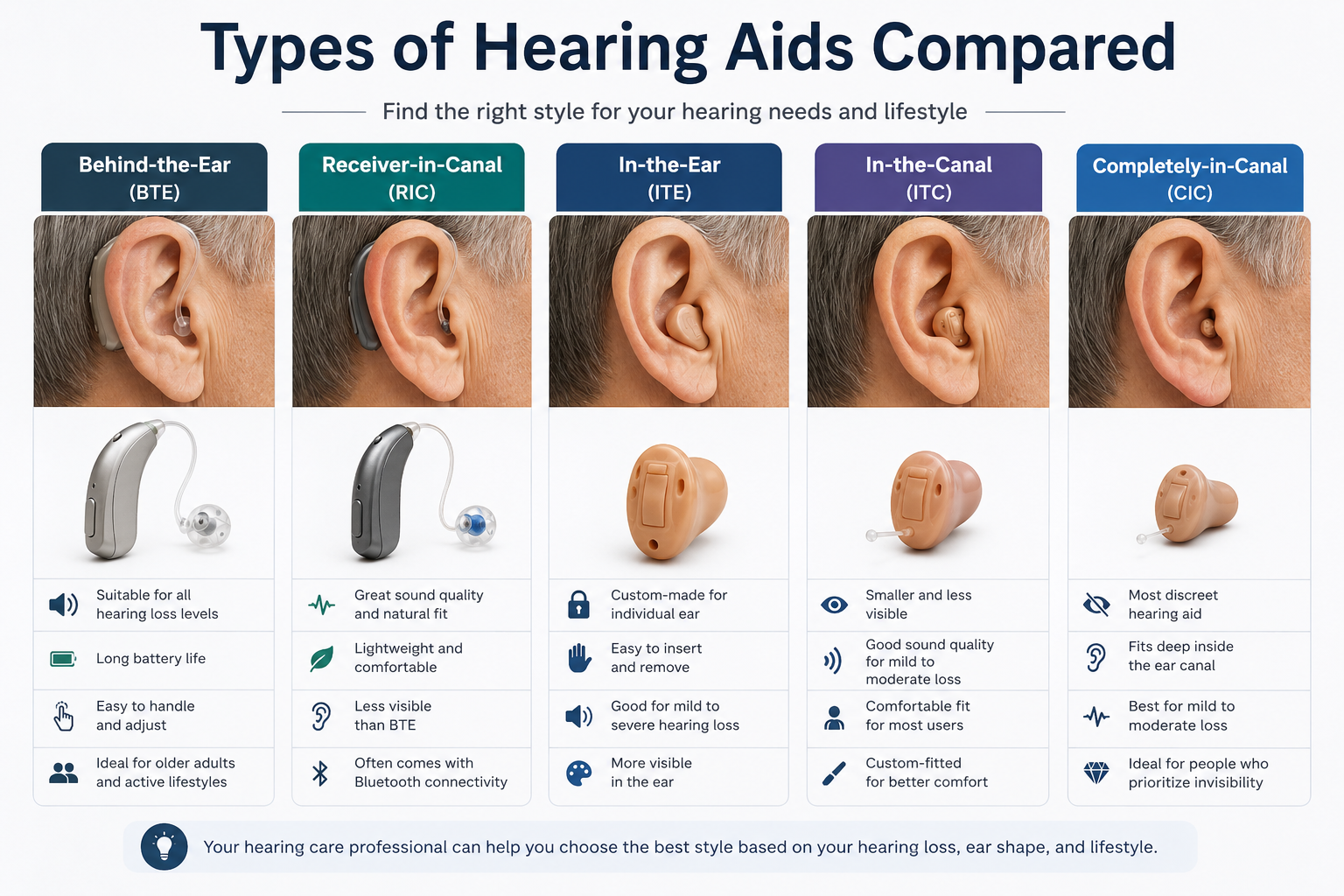
Behind-the-Ear (BTE) hearing aids are one of the most popular and reliable types of hearing aids available today. A BTE hearing aid sits comfortably behind the ear and connects to a custom earmould or ear tip inside the ear canal through a thin tube. Thanks to their powerful technology and durable design, BTE hearing aids are suitable for people with mild, moderate, severe, and profound hearing loss.
Modern digital BTE hearing aids offer advanced features such as Bluetooth connectivity, rechargeable batteries, AI-powered noise reduction, feedback cancellation, and improved speech clarity, making them an excellent choice for both everyday conversations and noisy environments.
Receiver-in-Canal (RIC / RITE)
Receiver-in-Canal (RIC), also known as Receiver-in-the-Ear (RITE), is one of the most popular types of hearing aids available today. A RIC hearing aid is similar to a Behind-the-Ear (BTE) hearing aid, but instead of placing the speaker inside the main body, the tiny receiver is positioned directly inside the ear canal and connected by a thin, almost invisible wire. This design provides a more natural listening experience while keeping the hearing aid lightweight and discreet.
Modern digital RIC hearing aids are widely recommended by audiologists because they combine excellent sound quality, advanced technology, and all-day comfort. Many models include Bluetooth connectivity, rechargeable batteries, AI-powered speech enhancement, and automatic background noise reduction, making them suitable for everyday conversations as well as noisy environments.
In-the-Ear, In-the-Canal & Completely-in-Canal (ITE / ITC / CIC)
In-the-Ear (ITE), In-the-Canal (ITC), and Completely-in-Canal (CIC) are popular types of hearing aids designed for people who prefer a discreet and comfortable hearing solution. Unlike BTE hearing aids or RIC hearing aids, these custom hearing aids fit directly inside the ear and are individually moulded to match the shape of your ear canal for a secure and personalized fit.
As you move from ITE to ITC and finally to CIC hearing aids, the devices become progressively smaller and less visible. CIC hearing aids are among the most discreet digital hearing aids available, making them an excellent choice for people who value cosmetic appearance while maintaining good hearing performance.
How to actually choose between these types of hearing aids
Choosing between the different types of hearing aids is about much more than appearance. The best hearing aid is one that matches your level of hearing loss, daily lifestyle, comfort preferences, and communication needs. A professional hearing test and consultation with a certified audiologist will help you select the most suitable digital hearing aid for long-term hearing success.
Why the fitting matters more than the style
Choosing between the different types of hearing aids is important, but the quality of your hearing aid fitting has an even greater impact on your hearing experience. Two people can wear the exact same digital hearing aid and achieve completely different results because every person’s hearing loss, ear anatomy, and listening needs are unique.
A professional hearing test and detailed hearing assessment allow a certified audiologist to accurately program your hearing aid according to your Pure Tone Audiometry (PTA) results. Proper hearing aid programming ensures that speech is clearer, background noise is reduced, and sounds are balanced to match your individual hearing profile. Even the best hearing aid cannot deliver its full performance if it is not professionally fitted and adjusted.
FAQs
Among the different types of hearing aids, Receiver-in-Canal (RIC) hearing aids are currently the most popular worldwide. RIC hearing aids are lightweight, discreet, and provide natural sound quality with excellent speech clarity. Many digital RIC hearing aids also include advanced features such as Bluetooth connectivity, rechargeable batteries, smartphone app control, and AI-powered noise reduction, making them a preferred choice for people with mild to severe hearing loss.
For people with severe to profound hearing loss, Behind-the-Ear (BTE) hearing aids are generally considered the best type of hearing aid. BTE hearing aids provide more amplification, larger batteries, better durability, and advanced sound-processing technology than smaller hearing aid styles. After a professional hearing test, a certified audiologist can recommend the most suitable digital hearing aid based on your level of hearing loss.
Yes, invisible hearing aids, such as Completely-in-Canal (CIC) hearing aids, can provide excellent hearing performance for people with mild to moderate hearing loss. However, because of their compact size, CIC hearing aids have limited amplification compared to BTE hearing aids or RIC hearing aids. If you have severe hearing loss, your audiologist may recommend a more powerful digital hearing aid for better speech understanding and overall hearing performance.
Absolutely. At Hear At Home, we offer a free hearing aid trial across a wide range of digital hearing aids and leading hearing aid brands. This allows you to experience different types of hearing aids, evaluate comfort, sound quality, and speech clarity in your daily routine before making a purchase. Our RCI-certified audiologists also provide professional hearing aid fitting and personalized programming to ensure the best hearing experience.
Yes. At Hear At Home, all our digital hearing aids include a 2-year manufacturer warranty for added peace of mind. Many models also feature water-resistant or waterproof protection, professional hearing aid fitting, ongoing servicing, and expert after-sales support, ensuring long-term reliability regardless of the type of hearing aid you choose.