
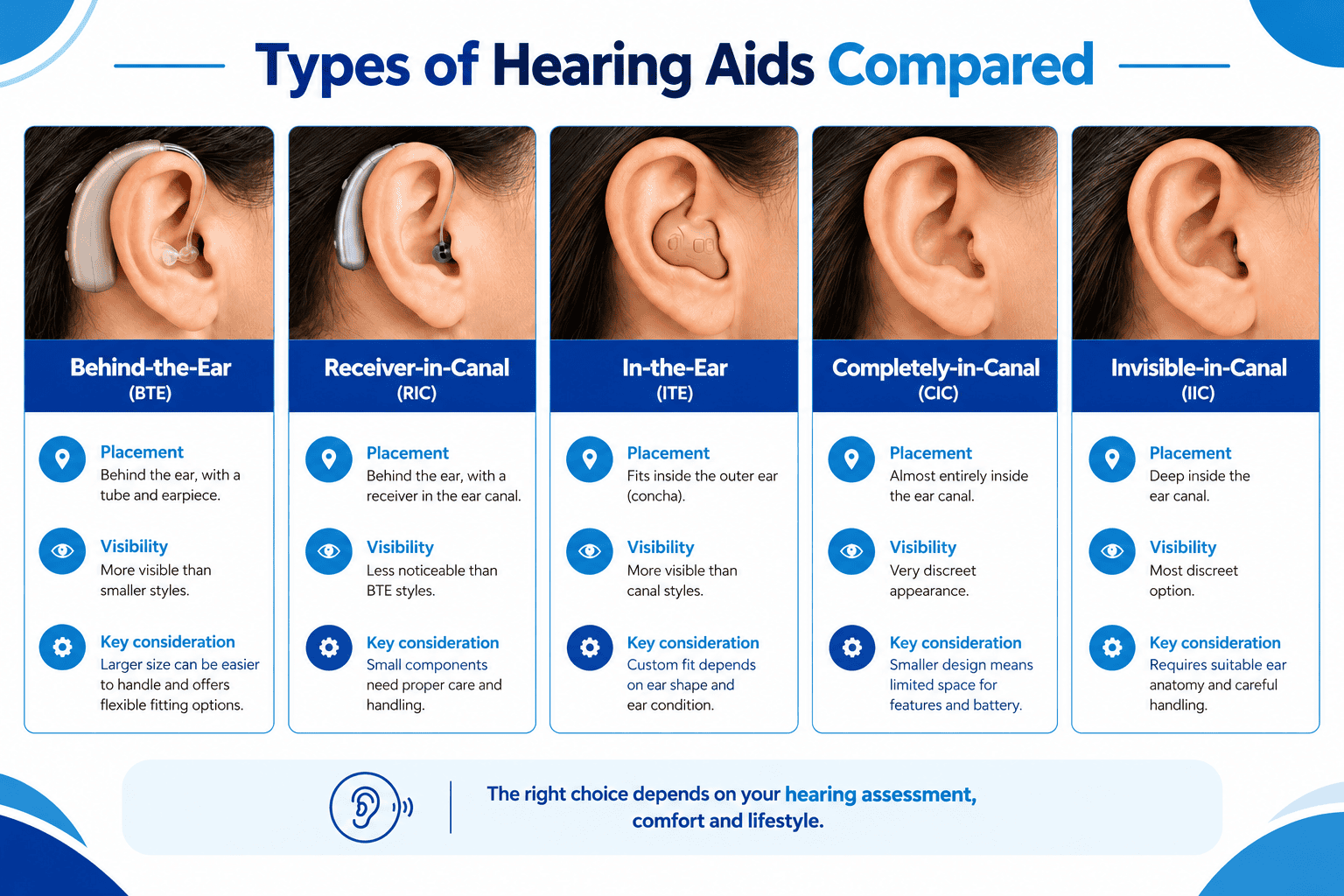
Hearing plays an important role in our daily lives. From talking to family members and attending phone calls to participating in social gatherings, good hearing helps us stay connected with the people around us. However, when hearing difficulties begin to affect everyday communication, even simple conversations can become challenging. Fortunately, modern hearing aids offer several options to help people hear sounds more comfortably.
But with so many models, designs and features available, choosing the right device can feel confusing. Understanding the types of hearing aids available is an important first step towards making an informed decision.
Hearing aids come in different shapes and sizes, including devices worn behind the ear and smaller models fitted inside the ear canal. Some are designed for easy handling, while others focus on a discreet appearance. Modern digital hearing aids may also include features such as background noise management, rechargeable batteries and Bluetooth connectivity, depending on the model.
At Hear At Home, we understand that every person’s hearing needs and lifestyle are different. Whether you are exploring hearing aids for yourself or a family member, learning about the available options can help you prepare for a discussion with a hearing care professional.
In this guide, we explain the types of hearing aids, their features, advantages, limitations and the factors to consider when selecting a suitable device. We also discuss how people in Sirsa, Hisar, Rohtak, Hanumangarh and Bathinda can approach hearing care.
What Is a Hearing Aid?
A hearing aid is an electronic device designed to make sounds more accessible to people with hearing loss. It picks up sound through a microphone, processes it electronically and delivers the processed sound through a small speaker called a receiver.
Unlike a simple sound amplifier, a modern digital hearing aid can be programmed to suit an individual’s hearing profile. Depending on the device, it may adjust amplification across different sound frequencies and provide features intended to improve listening comfort.
Hearing aids are available in different styles, technologies and power levels. The appropriate option depends on several factors, including the degree and type of hearing loss, ear anatomy, communication requirements, personal preferences and budget.
A hearing aid does not restore normal hearing in every situation. However, a properly selected and fitted device may help many people hear speech and everyday sounds more effectively.
A hearing assessment by a qualified hearing care professional is an important starting point before choosing among the different types of hearing aids.
What Are the Different Types of Hearing Aids?
The main types of hearing aids are classified according to where they sit on or inside the ear.
The most common styles include:
Behind-the-ear (BTE) hearing aids
Receiver-in-canal (RIC) hearing aids
In-the-ear (ITE) hearing aids
In-the-canal (ITC) hearing aids
Completely-in-canal (CIC) hearing aids
Invisible-in-canal (IIC) hearing aids
Bone-conduction hearing devices
CROS and BiCROS hearing systems
Each design has its own characteristics. Some offer larger controls and easier handling, while others have a smaller profile. Not every style is suitable for every type or degree of hearing loss.
Let’s look at these options in detail.
1. Behind-the-Ear (BTE) Hearing Aids
Behind-the-ear hearing aids, commonly called BTE hearing aids, are among the most widely recognised hearing aid styles.
How Do BTE Hearing Aids Work?
The main electronic components are housed in a small case that rests behind the ear. A tube connects this case to an earmould or earpiece positioned in the outer ear.
The earmould helps direct sound into the ear and can be customised for the wearer.
Benefits of BTE Hearing Aids
BTE devices offer several practical advantages:
Easy handling: Their larger design can make them easier to hold, insert and remove.
Flexible fitting: Different earmoulds can be used to accommodate changes in fit.
Suitable power options: Depending on the model, BTE devices can accommodate a wide range of hearing loss.
Practical maintenance: Many models are relatively straightforward to clean and maintain.
Options for different ages: They are available for adults, senior citizens and children, with appropriate fitting.
Who Should Consider BTE Hearing Aids?
BTE hearing aids may be suitable for people who prefer a device that is easier to handle or require a particular level of amplification.
They can be worth considering for older adults who find very small devices difficult to manage.
However, the most suitable model depends on the hearing assessment, ear condition and individual requirements.
2. Receiver-in-Canal (RIC) Hearing Aids
Receiver-in-canal hearing aids, also known as RIC or RITE hearing aids, are another popular option.
They look similar to BTE devices, but their internal design is different.
How Do RIC Hearing Aids Work?
The main body sits behind the ear. A thin wire connects it to a small receiver positioned inside the ear canal.
This arrangement allows the main device to remain relatively small while placing the speaker closer to the eardrum.
RIC hearing aids are available in various configurations, including models with rechargeable batteries and wireless connectivity.
Benefits of RIC Hearing Aids
Some of the main advantages include:
Discreet design: The smaller casing and thin wire can make the device less noticeable.
Comfortable fit: Many models use a small dome or a custom earmould.
Modern features: Depending on the model, features may include Bluetooth streaming, noise management and rechargeable batteries.
Flexible listening options: Different programmes may be available for conversations, telephone calls and other listening situations.
Who Should Consider RIC Hearing Aids?
RIC devices may be appropriate for adults who prefer a smaller behind-the-ear design and need features suited to their daily listening habits.
They can be considered by people who regularly attend meetings, speak on the phone or participate in social activities.
However, the receiver and wire require appropriate care, and some users may find the small components difficult to handle.
An audiologist can help determine whether RIC hearing aids are suitable for your hearing profile.
3. In-the-Ear (ITE) Hearing Aids
In-the-ear hearing aids are designed to fit within the outer ear rather than behind it.
How Do ITE Hearing Aids Work?
The electronic components are housed in a custom-made shell shaped to fit the wearer’s ear.
Unlike BTE and RIC devices, an ITE hearing aid does not have a separate casing worn behind the ear.
ITE devices are available in different sizes. Some occupy much of the outer ear, while smaller designs fit closer to the ear canal.
Benefits of ITE Hearing Aids
The main advantages include:
Custom fit: The shell is designed around the shape of the wearer’s ear.
No behind-the-ear casing: Some people prefer having the device contained within the ear.
Potentially easier handling: Larger ITE models may be easier to manage than very small canal devices.
Available features: Depending on the model, features may include directional microphones, volume controls and wireless connectivity.
Who Should Consider ITE Hearing Aids?
ITE hearing aids may suit people who prefer an all-in-the-ear design and want a device tailored to their ear shape.
Some larger models may also be easier to insert and remove than very small hearing aids.
However, the fit depends on ear anatomy, and the device may be less suitable for people with certain ear conditions.
A hearing care professional can assess whether an ITE model is appropriate.
4. In-the-Canal (ITC) Hearing Aids
In-the-canal hearing aids are smaller devices designed to sit partly inside the ear canal.
What Makes ITC Hearing Aids Different?
Unlike ITE devices, which occupy more of the outer ear, ITC hearing aids fit closer to the ear canal opening.
They are generally custom-made and designed around the individual’s ear anatomy.
Benefits of ITC Hearing Aids
The advantages of ITC hearing aids may include:
Smaller appearance: They are generally less noticeable than larger ITE models.
Customised fit: Their shape is designed to fit the wearer’s ear.
Convenient placement: They do not require a casing behind the ear.
Available controls: Certain models offer adjustable settings, depending on their size and design.
What Are Their Limitations?
Because ITC hearing aids are smaller, their controls may be more difficult to operate.
Their size can also limit the space available for batteries and certain additional features.
People with limited finger dexterity should consider whether they can comfortably insert, remove and maintain the device.
ITC hearing aids are not automatically the best choice simply because they are less visible. Hearing requirements and ease of use should remain priorities.
5. Completely-in-Canal (CIC) Hearing Aids
Completely-in-canal hearing aids are designed to fit almost entirely inside the ear canal.
They are smaller than most ITE and ITC devices.
What Are the Benefits of CIC Hearing Aids?
CIC hearing aids may appeal to people who prefer a discreet appearance.
Their potential benefits include:
Low visibility: Much of the device sits inside the ear canal.
Compact construction: They do not have a large casing behind the ear.
Custom fit: They are generally manufactured to match the wearer’s ear canal.
Are CIC Hearing Aids Suitable for Everyone?
No. The compact design has certain limitations.
Small controls can be difficult to manage, and the device may have less space for batteries and additional technology than larger models.
Earwax, moisture and the shape of the ear canal can also affect suitability and maintenance.
CIC hearing aids may be considered by people whose hearing needs and ear anatomy are compatible with this design.
Before selecting a CIC device, discuss its practical advantages and limitations with a hearing care professional.
6. Invisible-in-Canal (IIC) Hearing Aids
Invisible-in-canal hearing aids are designed to sit deeper inside the ear canal than many other conventional hearing aid styles.
They are intended for people who prefer a particularly discreet device.
What Are the Advantages of IIC Hearing Aids?
Their main appeal is their small size and limited visibility from the outside.
Other potential benefits include:
No casing behind the ear.
A discreet appearance when correctly fitted.
A custom design intended to fit the ear canal.
What Should You Consider Before Choosing IIC Hearing Aids?
Although IIC devices can be less noticeable, their small size may make them harder to insert, remove and adjust.
They may also have fewer available features than larger hearing aids.
Not every ear canal can accommodate an IIC device, and not every hearing profile can be managed by this style.
People who have difficulty handling small objects should consider these limitations carefully.
Important: The least visible hearing aid is not necessarily the most suitable one. Comfort, hearing requirements and everyday usability are more important than appearance alone.
7. Bone-Conduction Hearing Devices
Bone-conduction hearing devices work differently from conventional air-conduction hearing aids.
Instead of delivering sound through the ear canal in the usual way, they transmit vibrations through the skull to stimulate the inner ear.
How Do Bone-Conduction Devices Work?
A bone-conduction system uses a vibrating component to send sound through bone rather than relying solely on the usual route through the outer and middle ear.
Some devices are worn externally, while others are implantable and require specialist medical assessment.
Who May Benefit From Bone-Conduction Devices?
These devices may be considered for certain types of conductive or mixed hearing loss, or when conventional hearing aids are unsuitable because of particular ear conditions.
However, suitability depends on the underlying hearing problem and the condition of the inner ear.
An audiologist or ENT specialist can determine whether this approach is appropriate.
Bone-conduction devices are not interchangeable with all conventional hearing aids, so a proper assessment is essential.
8. CROS and BiCROS Hearing Systems
CROS and BiCROS systems are specialised options for people with significantly different hearing abilities between their two ears.
They are different from conventional hearing aids because their primary purpose is to route sound from one side to the other.
What Is a CROS Hearing System?
CROS stands for Contralateral Routing of Signals.
A microphone on the side with unaidable hearing picks up sound and transmits it to a device worn on the better-hearing ear.
This can help the wearer access sounds coming from the side where hearing is poorer.
What Is a BiCROS Hearing System?
BiCROS systems are intended for people who have unaidable hearing in one ear and hearing loss in the other ear.
The system routes sound from the poorer-hearing side to the better-hearing side while also providing amplification for the better ear when required.
Are CROS and BiCROS Systems Suitable for Everyone?
These systems may help in specific hearing situations, but they do not restore normal hearing in the poorer ear.
A detailed hearing assessment is necessary to determine whether a CROS or BiCROS system is appropriate.
People experiencing hearing loss in only one ear should discuss their options with a qualified hearing care professional.
Types of Hearing Aids at a Glance
The following table provides a quick comparison of the main types of hearing aids.
| Type | Where It Sits | Main Advantage | Important Consideration |
|---|---|---|---|
| BTE | Behind the ear | Often easier to handle | More visible than smaller styles |
| RIC | Behind the ear, with receiver in the canal | Compact design and flexible features | Small components require care |
| ITE | Outer ear | Custom fit and potentially easier handling than smaller models | More visible than canal styles |
| ITC | Partly inside the ear canal | Smaller appearance | Small controls may be difficult to use |
| CIC | Almost entirely inside the ear canal | Discreet design | Limited space for components |
| IIC | Deep inside the ear canal | Very discreet appearance | Requires suitable ear anatomy and careful handling |
| Bone-conduction device | External or implantable system, depending on the design | Provides an alternative sound transmission route | Requires specialist assessment |
| CROS/BiCROS | Devices worn on both sides | Routes sound from one side to the other | Designed for specific hearing needs |
These categories describe general design differences. Features, performance and suitability vary by manufacturer and model.
Digital Hearing Aids vs Analogue Hearing Aids
Apart from physical design, hearing aids can also be classified according to their sound-processing technology.
Digital Hearing Aids
Digital hearing aids use electronic processing to analyse and modify incoming sound.
Depending on the model, they may offer:
Adjustable amplification across different frequencies.
Noise-management features.
Feedback reduction.
Multiple listening programmes.
Bluetooth connectivity.
Rechargeable battery options.
Digital devices are available in several physical styles, including BTE, RIC, ITE and canal models.
Analogue Hearing Aids
Analogue hearing aids amplify sound using analogue electronic circuitry.
Traditional analogue devices generally offer less sophisticated sound-processing options than modern digital models.
The availability of analogue devices may vary, and many contemporary hearing aid ranges focus on digital technology.
Which Type Is Better?
There is no single answer for everyone.
The right choice depends on the individual’s hearing assessment, listening requirements, comfort, budget and the features offered by a particular device.
It is better to compare the actual capabilities of available models than to select a hearing aid based on technology labels alone.
How to Choose the Right Type of Hearing Aid
Understanding the types of hearing aids is only the first step. Choosing a suitable device requires consideration of your hearing needs and everyday routine.
Here are the key factors to discuss with a hearing care professional.
1. Get Your Hearing Tested
A hearing assessment helps identify the degree and type of hearing loss.
The results can guide decisions about the appropriate hearing aid style, power level and programming requirements.
Avoid choosing a device based only on online descriptions or recommendations from friends and relatives.
2. Consider Your Daily Listening Needs
Think about the situations in which you experience the most difficulty.
For example, you may struggle to follow conversations in crowded places, hear television dialogue clearly or understand people speaking from another room.
Tell your hearing care professional about these situations. They can help identify features that may be useful for your routine.
3. Check Comfort and Fit
A hearing aid should fit comfortably and remain secure during normal activities.
Custom-fit devices may be appropriate for some people, while others may prefer a model with a dome or earmould.
The shape of your ear and the condition of your ear canal can influence which designs are suitable.
4. Think About Ease of Use
Consider whether you can comfortably insert, remove, clean and adjust the device.
Larger hearing aids may have easier-to-handle controls, while very small models may require more precise movements.
This is particularly important when choosing hearing aids for senior citizens or people with limited finger dexterity.
5. Compare Battery Options
Some hearing aids use replaceable batteries, while others have rechargeable batteries.
Rechargeable models may be convenient for people who prefer charging a device rather than regularly changing small batteries.
However, battery life, charging time and available charging accessories differ between models.
Choose an option that fits your daily routine.
6. Review Connectivity and Additional Features
Depending on the model, modern hearing aids may offer Bluetooth streaming, smartphone applications, directional microphones and different listening programmes.
These features can be useful for certain listening situations, but they may not be necessary for everyone.
Ask which features are included in the specific model you are considering.
7. Consider the Total Cost
The cost of a hearing aid can vary according to its design, technology, features, brand and service package.
When comparing prices, check what is included. This may cover fitting, programming, follow-up appointments, maintenance guidance and warranty support, depending on the provider.
The most expensive model is not automatically the best option for your needs.
Why Professional Hearing Aid Fitting Matters
Selecting from the different types of hearing aids is only one part of the process. Proper fitting and adjustment are also important.
A hearing care professional can help with several steps.
Hearing assessment: Understanding the person’s hearing profile and identifying any concerns that require medical attention.
Device selection: Comparing appropriate hearing aid styles, technology levels and features.
Fitting and programming: Adjusting the device according to the assessment and the individual’s listening needs.
Usage guidance: Explaining how to insert, remove, clean, charge and store the hearing aid.
Follow-up support: Reviewing comfort and listening experiences and making adjustments where needed.
New users may need time to become comfortable with amplified sounds. Follow-up appointments provide an opportunity to discuss any difficulties and review the settings.
Hearing aids should not be selected solely on the basis of appearance, price or amplification claims. A suitable device should match the person’s hearing requirements and practical needs.
Finding Hearing Aids in Sirsa, Hisar and Nearby Cities
Access to hearing care is important for people who want to explore their options without unnecessary confusion.
Hear At Home serves as a relevant starting point for people researching hearing aid options in Sirsa, Hisar, Rohtak, Hanumangarh and Bathinda.
If you or a family member is experiencing difficulty hearing conversations, following television programmes or understanding speech in social settings, consider arranging a hearing assessment.
When exploring hearing aids in Sirsa, look for guidance on hearing assessment, suitable device options and fitting support.
Similarly, people researching hearing aids in Hisar or Rohtak can compare different styles and ask about features that suit their everyday listening requirements.
For residents of Hanumangarh and Bathinda, understanding the differences between BTE, RIC, ITE and other devices can help prepare them for a more informed discussion with a hearing care professional.
Before choosing a provider, ask about the services available in your location, the hearing assessment process, fitting appointments and aftercare arrangements.
You can visit Hear At Home at hearathome.in to explore the available information and enquire about suitable hearing care services.
Please confirm current service availability, appointment options and any home-visit facilities directly with Hear At Home before making location-specific claims or arrangements.
Common Mistakes to Avoid When Buying Hearing Aids
Choosing a hearing aid without understanding its features can lead to unnecessary expense or practical difficulties.
Keep these common mistakes in mind.
Choosing Only by Appearance
Small hearing aids may look attractive, but they are not suitable for everyone.
A larger device may offer easier handling, more space for controls or features better suited to your hearing requirements.
Buying Without a Hearing Assessment
Different hearing problems require different approaches.
A professional assessment helps determine whether conventional hearing aids or another form of hearing care is appropriate.
Ignoring Comfort
A hearing aid should be comfortable enough for regular use.
If the device feels uncomfortable, whistles repeatedly or does not fit securely, seek professional advice rather than attempting major adjustments yourself.
Overlooking Maintenance
Hearing aids need regular care.
Follow the manufacturer’s instructions for cleaning, moisture protection, charging and storage. Regular maintenance can help keep the device functioning as intended.
Expecting Immediate Results in Every Situation
Getting used to hearing aids may take time.
The listening experience can vary between quiet conversations, busy markets, family gatherings and other environments.
Follow-up adjustments may help address difficulties, but individual results vary.
Conclusion:
Understanding the types of hearing aids available can make the selection process easier and help you ask the right questions before investing in a device.
BTE hearing aids may suit people who prefer practical handling and flexible fitting options. RIC devices offer a compact behind-the-ear design, while ITE, ITC, CIC and IIC models provide different options for people who prefer devices fitted within the ear.
Bone-conduction devices and CROS/BiCROS systems may be appropriate for particular hearing conditions following specialist assessment.
However, the best choice is not necessarily the smallest, most advanced or most expensive device. It is the one that matches your hearing requirements, fits comfortably and supports your everyday communication needs.
If you are exploring hearing aids for yourself or a family member, begin with a hearing assessment and discuss the available options with a qualified hearing care professional.
Whether you are researching hearing aids in Sirsa, Hisar, Rohtak, Hanumangarh or Bathinda, understanding your options is a valuable first step.
Explore Hear At Home at hearathome.in to learn more about hearing care and enquire about suitable hearing aid options.
Disclaimer: This article provides general educational information and is not a substitute for professional medical advice, diagnosis or treatment. Hearing aid suitability should be assessed individually. Consult a qualified hearing care professional or ENT specialist for personalised guidance.