What Is an Audiometry Test?
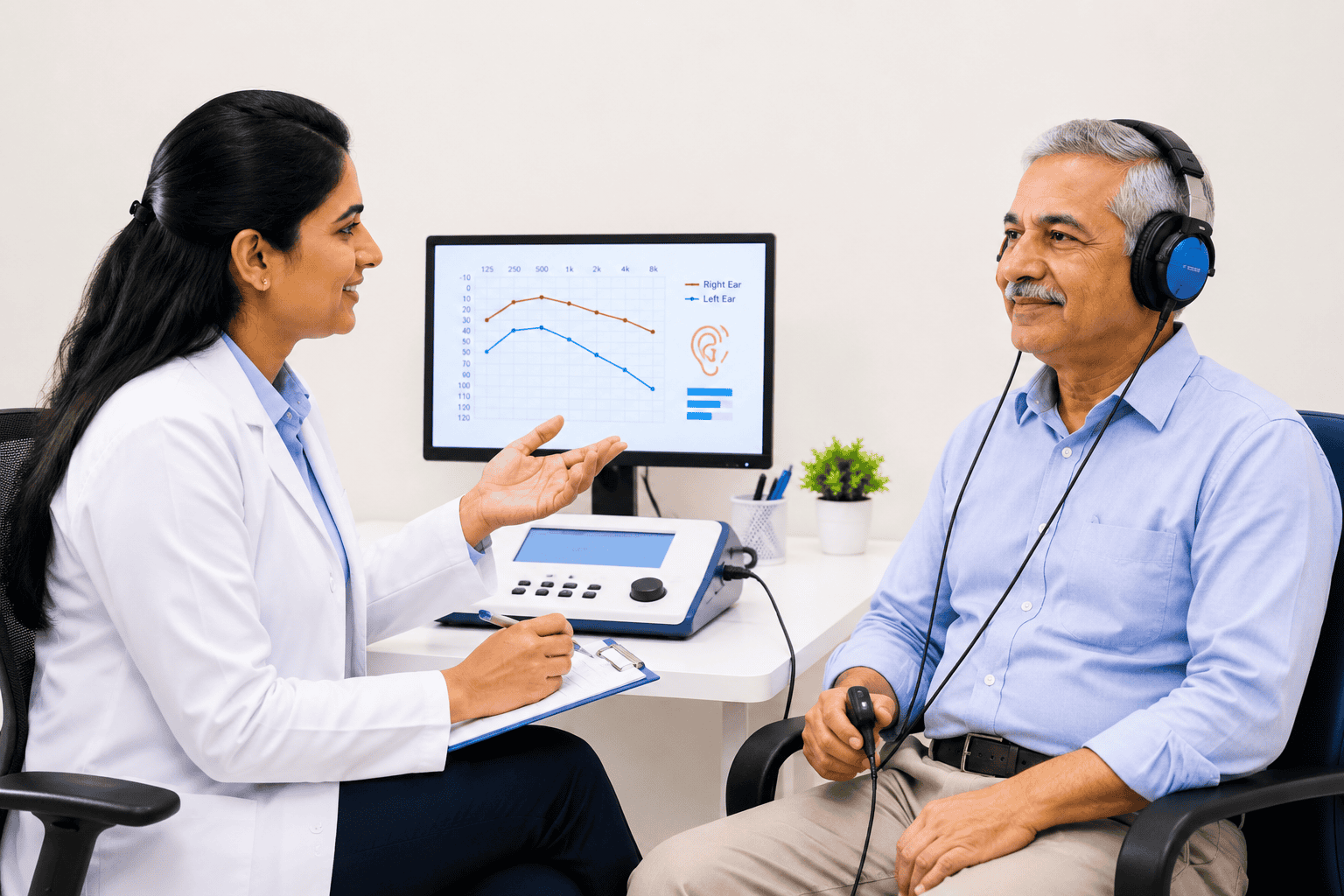
An audiometry test is a professional hearing assessment used to determine how well a person can hear different sounds, pitches and levels of loudness. One of the most common forms is Pure Tone Audiometry (PTA), where an audiologist presents tones at different frequencies and records the softest level a person can hear.
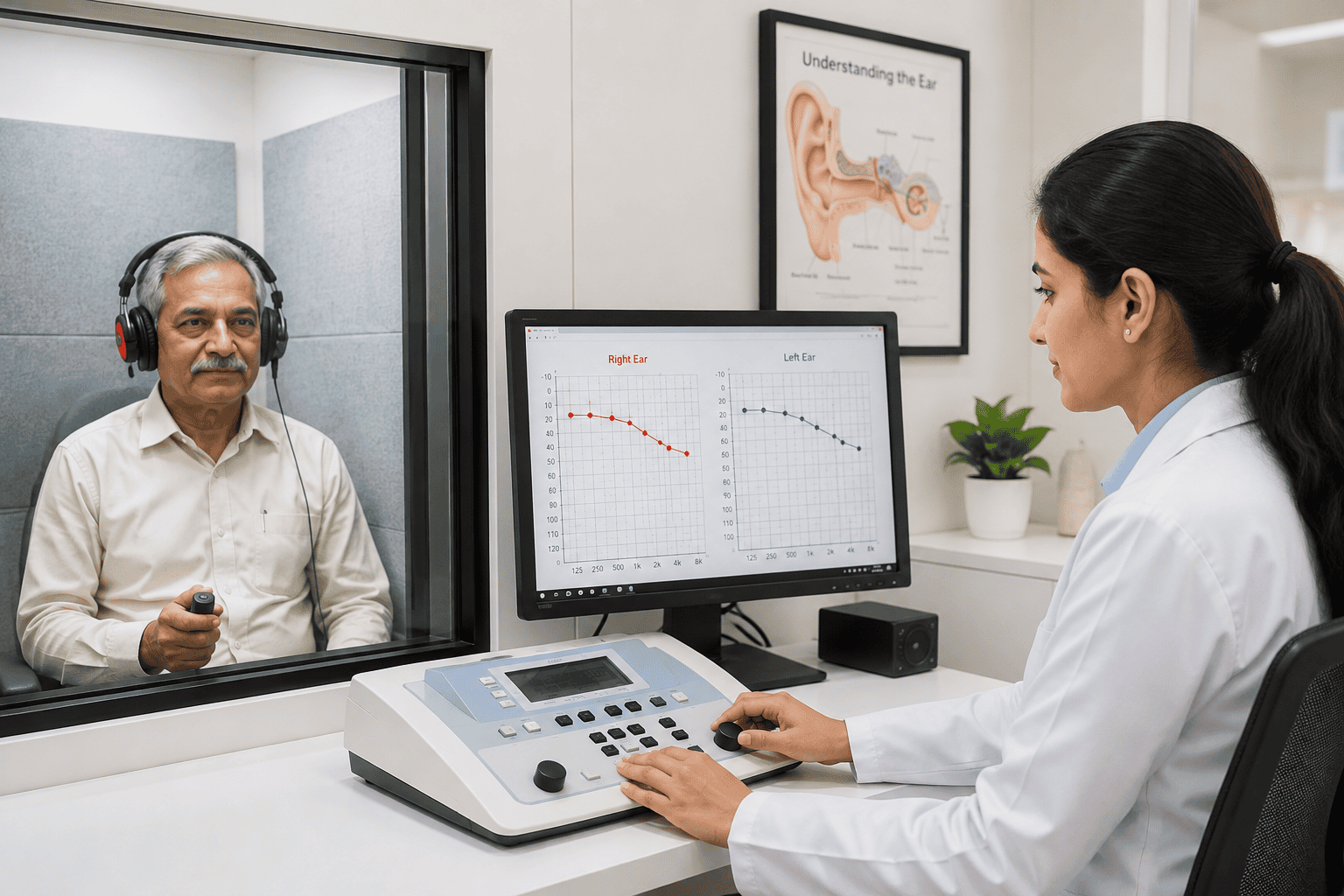
The results are shown on an audiogram, which provides a visual representation of hearing sensitivity in each ear. Pure-tone audiometry is widely used to identify the presence, type and degree of hearing loss.
A hearing test can be useful for someone who is struggling to understand conversations, frequently asks others to repeat themselves, turns up the television volume, notices ringing in the ears, or simply wants to monitor their hearing.
At Hear At Home, hearing assessments include Pure Tone Audiometry performed by certified audiologists, with home-visit options available for people who have difficulty travelling.
Why Is an Audiometry Test Important?
Hearing loss can develop gradually, which means many people do not immediately realise that their hearing has changed.
You may adapt by increasing the TV volume, watching people’s lips while they speak, avoiding conversations in noisy environments or asking family members to repeat themselves.
A professional hearing assessment helps replace guesswork with measurable information.
An audiometry test can help:
- Identify whether hearing loss is present.
- Determine the degree of hearing difficulty.
- Compare hearing between the two ears.
- Identify which frequencies are affected.
- Establish a baseline for future hearing monitoring.
- Support decisions about hearing rehabilitation.
- Help an audiologist recommend appropriate hearing solutions when required.
The World Health Organization notes that many people with hearing loss are unaware of it and that regular hearing checks can support earlier identification and action.
Importantly, an online hearing screening or mobile hearing-checking tool should not be treated as a replacement for a professional diagnostic assessment. WHO specifically states that screening tools do not replace evaluation by a qualified hearing professional.
How Does an Audiometry Test Work?
A typical pure tone audiometry assessment measures your hearing sensitivity at different frequencies.
During the test, you usually wear headphones or insert earphones. The audiologist presents sounds and asks you to respond whenever you hear them.
The tones may vary in:
- Frequency: the pitch of the sound, measured in Hertz (Hz).
- Intensity: how loud the sound is, commonly represented in decibels (dB).
The audiologist gradually determines the quietest level at which you can hear particular tones.
Pure-tone testing can include air-conduction and, when clinically indicated, bone-conduction measurements. Professional audiometry procedures also take the test environment, equipment and calibration into account because these factors can influence the reliability of measurements.
This is why a proper hearing assessment should be conducted using appropriate equipment and procedures by a trained professional.
What Happens During a Pure Tone Audiometry Test?
If you have never had a hearing test before, the process is usually straightforward.
1. Hearing History
The audiologist may first ask questions about your hearing and ear health.
You may be asked about:
- Difficulty understanding speech.
- Ringing or buzzing in the ears.
- Exposure to loud sounds.
- Previous ear infections.
- Sudden or gradual changes in hearing.
- Hearing difficulties in one or both ears.
- Previous hearing tests or hearing-aid use.
This information helps the audiologist understand your concerns and decide which assessments may be appropriate.
2. Ear Examination
Depending on the assessment, an ear examination may be performed before audiometry.
Checking the ear canal can help identify issues such as excessive earwax or other conditions that could affect testing. Professional audiometry guidance recommends appropriate ear examination before threshold testing.
3. Air-Conduction Testing
You will generally wear headphones or insert earphones.
Different tones are presented to each ear, and you respond when you hear them.
The audiologist records your responses to determine hearing thresholds at different frequencies.
4. Bone-Conduction Testing
When clinically required, a small bone vibrator may be positioned behind the ear.
Instead of sending sound through the outer and middle ear in the same way as headphones, bone-conduction testing provides additional information about how sound is perceived through the inner-ear pathway.
This can help the audiologist understand the nature of a hearing loss.
5. Results and Explanation
After testing, the audiologist reviews the results and explains what they mean.
At Hear At Home, the website states that its hearing assessment process includes professional evaluation and personalised recommendations based on individual hearing needs.
What Is an Audiogram?
An audiogram is the chart used to display hearing-test results.
It typically shows:
- Frequency on the horizontal axis.
- Hearing level/intensity on the vertical axis.
Frequency represents pitch, while the hearing-level scale helps show the softest sounds detected during testing.
The audiogram allows an audiologist to identify patterns in hearing sensitivity rather than relying only on a person’s description of their hearing.
For example, someone may have relatively better hearing for some frequencies but reduced sensitivity at others.
This matters because hearing loss is not always the same across the entire frequency range.
A person may therefore say, “I can hear sounds, but I cannot understand speech clearly,” even though they are not completely unable to hear.
An audiologist interprets the complete pattern rather than focusing on one number.
How Is Hearing Loss Identified?
Hearing loss can vary in degree and pattern.
The World Health Organization describes different degrees of hearing loss, ranging from mild difficulty with softer speech or speech in noisy environments to more severe levels of hearing difficulty.
An audiometry test can help determine whether hearing sensitivity is within expected limits or whether there is evidence of hearing loss.
However, the audiogram should not be interpreted in isolation.
The audiologist considers:
- Your symptoms.
- Your medical and hearing history.
- Both ears.
- Air- and bone-conduction results when appropriate.
- Speech understanding where required.
- Other test results when indicated.
Additional assessments may sometimes be recommended, such as speech audiometry, tympanometry, OAE or BERA/ASSR testing.
Hear At Home lists OAE and BERA/ASSR testing among its hearing-care services, particularly for newborn and infant hearing assessment and brainstem-response testing.
When Should You Get an Audiometry Test?
You should consider professional hearing assessment if you notice changes in your ability to hear or understand speech.
Common signs include:
- Frequently asking people to repeat themselves.
- Increasing the television or phone volume.
- Difficulty following conversations in restaurants or crowded places.
- Feeling that people are mumbling.
- Missing parts of conversations.
- Difficulty hearing high-pitched sounds.
- Hearing ringing or buzzing in the ears.
- Noticing that one ear hears differently from the other.
- Having a history of frequent ear problems.
- Working in a noisy environment.
- Regularly using loud personal audio devices.
WHO identifies factors such as older age, frequent loud-noise exposure, noisy workplaces, certain medicines and some ear diseases as factors associated with higher hearing-loss risk.
You do not have to wait until your hearing becomes severely affected before getting tested.
Early assessment can help identify a problem and determine what steps may be appropriate.
Is an Audiometry Test Painful?
No. A standard pure tone audiometry test is generally a non-invasive hearing assessment and should not be painful.
You typically sit comfortably while wearing headphones or other appropriate transducers and respond when you hear sounds.
The main requirement is concentration. Some tones can be very soft, so it is important to listen carefully and respond according to the instructions given by the audiologist.
If you experience ear pain, discharge, sudden hearing changes or another concerning symptom, tell the hearing professional before testing.
How Long Does an Audiometry Test Take?
A standard Pure Tone Audiometry test commonly takes around 20–30 minutes, although the exact duration can vary depending on the person and the assessments required.
Hear At Home states that its standard PTA hearing test usually takes around 20–30 minutes and includes evaluation of hearing ability, explanation of results and discussion of appropriate hearing-care options where necessary.
A more comprehensive hearing assessment can take longer if additional tests are required.
The goal should not simply be to finish quickly. The quality and reliability of the assessment are more important than rushing through the appointment.
Audiometry Test for Children and Adults
Hearing assessment is important at different stages of life.
For adults, testing may be recommended because of age-related changes, noise exposure, tinnitus, communication difficulties or other hearing concerns.
For children, hearing assessment can be especially important when there are concerns about speech, language, school performance, responses to sound or developmental milestones.
Different tests may be appropriate depending on age and the child’s ability to participate.
WHO educational material explains that pure tone audiometry can be used for children above certain ages who can reliably respond to the test, while other hearing-screening methods may be appropriate for younger children.
A qualified audiologist can determine which assessment is suitable.
Audiometry Test at Home
For some people, travelling to a clinic is difficult.
Older adults, people with mobility challenges, busy families and individuals who live some distance from a hearing clinic may prefer a home-visit service.
Hear At Home offers home hearing consultations and states that its audiologists can visit patients at home for testing, consultation or hearing-aid fitting. Its website lists home hearing services across Sirsa, Hisar, Bhiwani, Rohtak, Gurugram, Bathinda and Hanumangarh.
A home assessment still needs an appropriate testing environment and suitable professional procedures.
If you are considering a home hearing test, ask the provider:
- Who will conduct the assessment?
- What type of hearing test will be performed?
- What equipment will be used?
- Will the results be explained to you?
- Will additional testing be recommended if necessary?
These questions can help you understand the quality and scope of the service.
What Happens After the Hearing Test?
An audiometry test is not simply about receiving a chart.
The next step is understanding what the results mean for you.
Depending on the findings, an audiologist may recommend:
- Monitoring your hearing.
- Additional diagnostic testing.
- Medical or ENT evaluation when appropriate.
- Hearing protection and safe-listening advice.
- Hearing rehabilitation.
- Hearing-aid evaluation.
- Hearing-aid fitting and programming.
- Follow-up assessments.
Not everyone with hearing difficulty automatically needs a hearing aid.
The appropriate recommendation depends on the nature and degree of hearing loss, communication needs, lifestyle and other clinical considerations.
If hearing aids are recommended, professional fitting is important because amplification should be adjusted according to the individual’s hearing needs.
Hear At Home provides hearing-aid fitting, programming and ongoing support, and states that it offers multi-brand, unbiased advice and a free trial before purchase.
Why Choose a Professional Audiologist?
A hearing test is more useful when the results are obtained and interpreted properly.
In India, audiologists are among the rehabilitation professionals regulated through the Rehabilitation Council of India (RCI), which maintains the Central Rehabilitation Register. RCI’s current guidance states that professionals with recognised qualifications and valid registration are entitled to practise as rehabilitation professionals in India.
When choosing a hearing-care provider, consider:
- Professional qualifications.
- Valid professional registration where applicable.
- Appropriate hearing-test equipment.
- Proper testing procedures.
- Clear explanation of results.
- Follow-up support.
- Availability of additional assessments when needed.
- Transparent hearing-aid recommendations.
Hear At Home states that it works with certified RCI audiologists and provides personalised hearing assessments and hearing-care recommendations.
A professional hearing assessment should help you understand your hearing rather than simply encourage you to purchase a product.
Audiometry Test vs Online Hearing Test
Online hearing tests and smartphone-based screening tools can be useful for awareness, but they are not equivalent to a full clinical hearing assessment.
Online results can be affected by:
- Headphone quality.
- Device settings.
- Background noise.
- Room acoustics.
- User instructions.
- Calibration limitations.
WHO explains that hearing screening applications can help identify people who may need further assessment, but screening tools do not replace professional diagnostic testing.
If an online check suggests a possible problem—or if you already have symptoms—it is sensible to arrange a professional hearing assessment.
What Should You Do Before an Audiometry Test?
You usually do not need complicated preparation.
Before your appointment:
- Think about when you first noticed your hearing difficulty.
- Note whether one or both ears are affected.
- Mention tinnitus or dizziness if present.
- Tell the audiologist about previous ear problems.
- Mention significant noise exposure.
- Bring previous hearing-test reports if available.
- Ask questions about anything you do not understand.
Most importantly, follow the audiologist’s instructions during the test.
Do not worry about “getting the answers wrong.” The purpose of the assessment is to measure what you can actually hear.
Where to Get an Audiometry Test in Sirsa?
If you are searching for an audiometry test in Sirsa, Hear At Home provides hearing assessment services including Pure Tone Audiometry and professional consultation.
The clinic also provides home-visit hearing services for people who cannot easily travel. According to its website, its broader service network includes Sirsa, Hisar, Bhiwani, Rohtak, Gurugram, Bathinda and Hanumangarh.
Hear At Home’s website lists:
Phone: +91 70272-00355
Email: info.hearathome@gmail.com
Consultation Hours: 10 a.m. – 7 p.m.
The website also provides an appointment option for booking a hearing assessment.
Conclusion
An audiometry test is one of the most useful ways to understand your hearing ability. A professional assessment can identify changes in hearing sensitivity, show how each ear is performing and help an audiologist determine whether additional evaluation or hearing-care support is appropriate.
If you are frequently asking people to repeat themselves, struggling in noisy conversations, increasing the TV volume or noticing other changes in your hearing, do not rely only on guesswork or online screening tools.
A professional hearing assessment can give you a clearer picture of your hearing health.
For people in Sirsa and surrounding areas, Hear At Home provides Pure Tone Audiometry, professional hearing assessments, hearing-aid fitting and home-visit hearing services. The team states that its audiologists are RCI-certified and that personalised recommendations are provided according to individual hearing needs.
Your hearing affects conversations, relationships, work and everyday experiences. Getting it checked is a simple step toward understanding and protecting your hearing.