Hearing plays an important role in everyday communication. For senior citizens, being able to hear conversations clearly can make it easier to communicate with family members, participate in social activities and stay connected with the people around them.
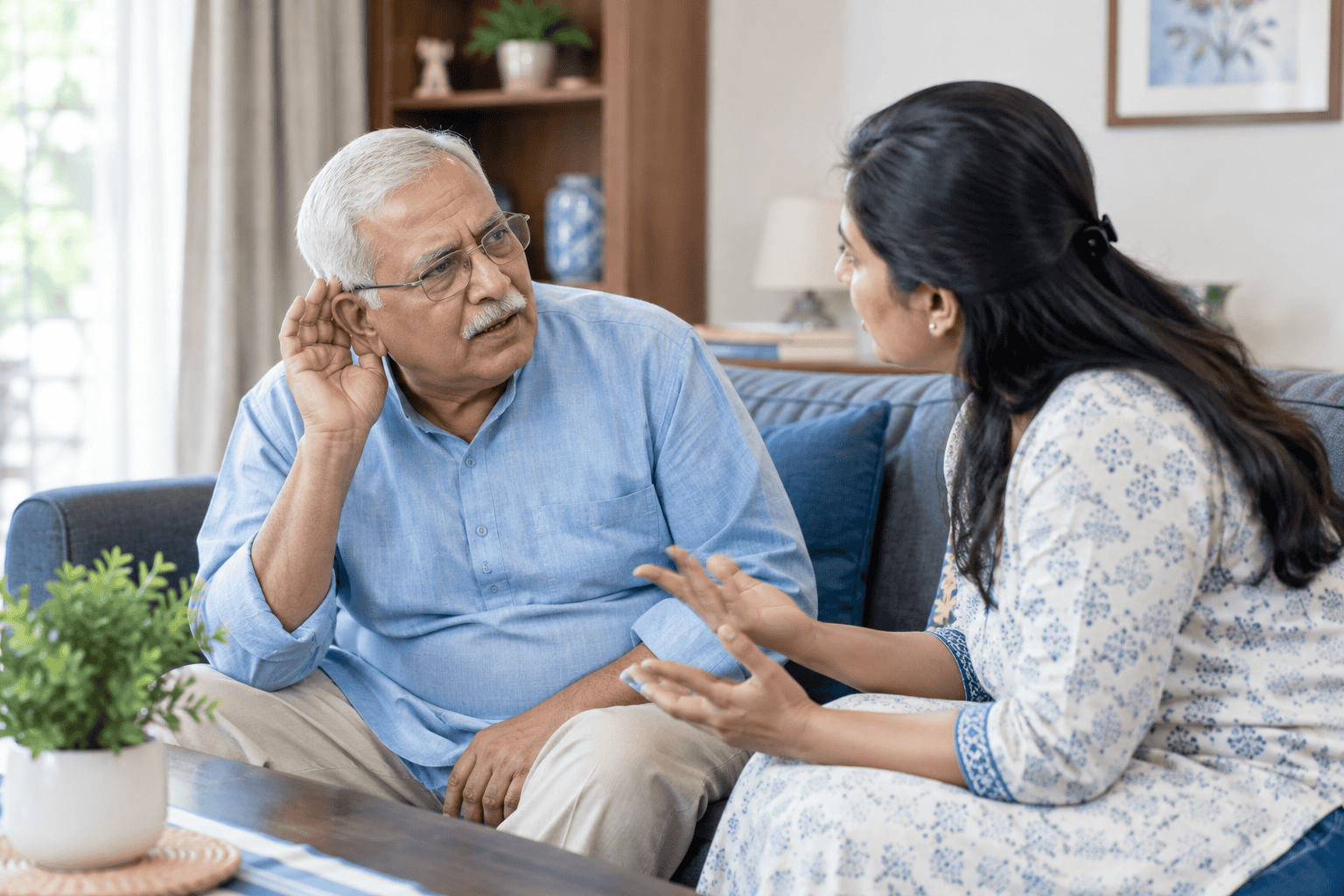
However, hearing changes can sometimes happen gradually. A senior citizen may not immediately notice that their hearing has changed. Family members may notice signs first, such as frequently asking others to repeat themselves, increasing the television volume or having difficulty following conversations in groups.
This is where a home hearing test for senior citizens can be a convenient first step towards understanding their hearing needs.
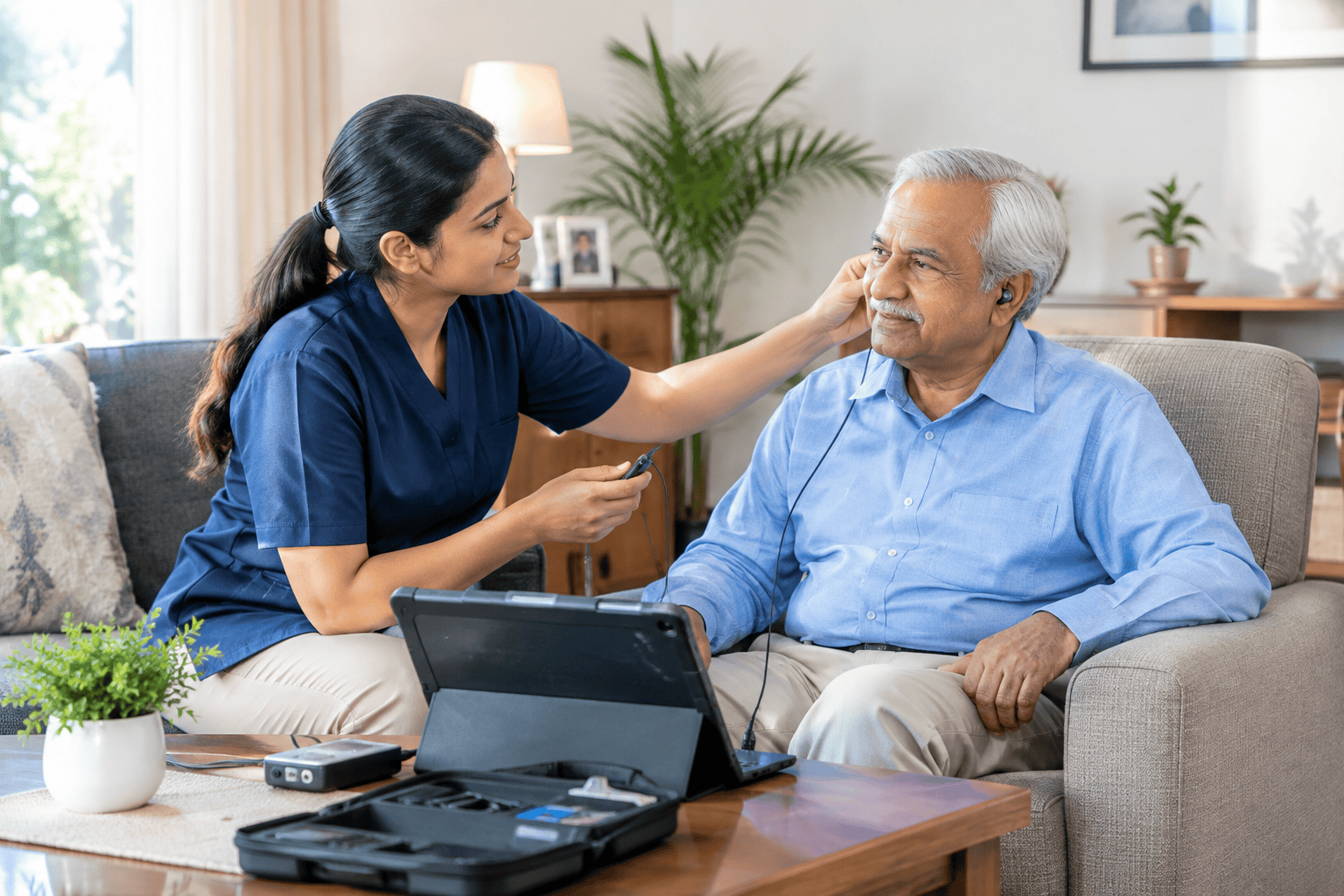
A professional hearing assessment at home can be particularly useful for older adults who find travelling to a clinic difficult or prefer to have their assessment in a familiar environment. Depending on the service and equipment available, a trained hearing professional can perform appropriate screening or assessment procedures at home and explain what the results mean.
The World Health Organization notes that hearing loss becomes more common with increasing age and recommends hearing screening for older adults. WHO guidance also recognises home settings as one possible location for hearing screening when appropriate.
For families looking for convenient hearing care in Sirsa, Hisar, Rohtak, Hanumangarh or Bathinda, understanding how a home hearing test for senior citizens works can make the process less confusing.
Why Consider a Home Hearing Test for Senior Citizens?
A clinic visit may not always be convenient for an older adult. Travelling, waiting, arranging transport or managing mobility difficulties can make a routine hearing appointment harder.
A home hearing test for senior citizens brings the assessment closer to the person’s everyday environment.
1. Convenience for Older Adults
One of the biggest advantages of a home hearing test for senior citizens is convenience.
Instead of arranging transportation to a hearing centre, families can arrange a hearing assessment at home when home-visit services are available in their area.
This can be particularly useful for seniors who have difficulty travelling independently or who feel more comfortable discussing their hearing concerns at home.
2. A Familiar and Comfortable Environment
Some senior citizens may feel more relaxed at home than in an unfamiliar clinical environment.
During a hearing test at home, the person can remain in a familiar setting while speaking with the hearing professional and discussing their daily listening difficulties.
A comfortable environment can also make it easier for family members or caregivers to participate in the conversation and provide useful observations.
3. Easier Involvement of Family Members
Hearing concerns are often noticed by family members before the senior recognises them.
For example, a son or daughter may notice that their parent:
- Keeps asking people to repeat themselves
- Turns the television volume up
- Has difficulty hearing on the phone
- Struggles during family gatherings
- Finds conversations difficult in noisy places
- Does not respond to softer sounds
WHO lists several of these as possible signs of age-related hearing loss.
With a home hearing test for senior citizens, family members can be present and help communicate these observations to the audiologist.
Common Signs That a Senior May Need a Hearing Test
Hearing loss does not always happen suddenly. In many cases, the changes can be gradual.
Some common signs that may indicate it is time to consider a senior hearing test include:
Frequently Asking People to Repeat Themselves
If an older adult regularly says “What?” or asks family members to repeat sentences, it may be worth arranging a hearing assessment.
Occasional difficulty hearing is normal in certain environments, but frequent communication problems should not simply be dismissed as a normal part of ageing.
Increasing the Television or Radio Volume
If the television is consistently much louder than other family members prefer, this may be one indication that the person is having difficulty hearing.
A home hearing test for senior citizens can help determine whether further hearing evaluation is appropriate.
Difficulty Understanding Conversations in Groups
Restaurants, family gatherings and other busy environments can make conversations harder to follow.
A person may hear that someone is speaking but struggle to understand the words clearly.
Difficulty Hearing on the Phone
Telephone conversations do not provide the same visual cues as face-to-face communication. If a senior regularly struggles to understand phone conversations, a hearing assessment may be useful.
Missing Doorbells, Alarms or Other Everyday Sounds
Difficulty hearing doorbells, telephones or alarms can also be a reason to consider professional hearing screening.
WHO specifically identifies difficulty hearing sounds such as doorbells, alarms and telephones among possible indications of hearing loss.
What Happens During a Home Hearing Test for Senior Citizens?
One common question families ask is: What should we expect during a home hearing test for senior citizens?
The exact process depends on the hearing professional, equipment and type of assessment being performed. A professional assessment may involve several steps.
Step 1: Discussion About Hearing Difficulties
The appointment may begin with a conversation about the person’s hearing.
The audiologist may ask about situations where hearing is difficult, such as:
- Family conversations
- Watching television
- Talking on the phone
- Hearing in noisy places
- Understanding speech
- Hearing sounds from different directions
The family can also explain changes they have noticed.
Step 2: Basic Ear and Hearing History
The professional may ask about previous hearing problems, ear-related concerns, noise exposure, previous hearing tests or hearing devices.
This information can help provide context for the assessment.
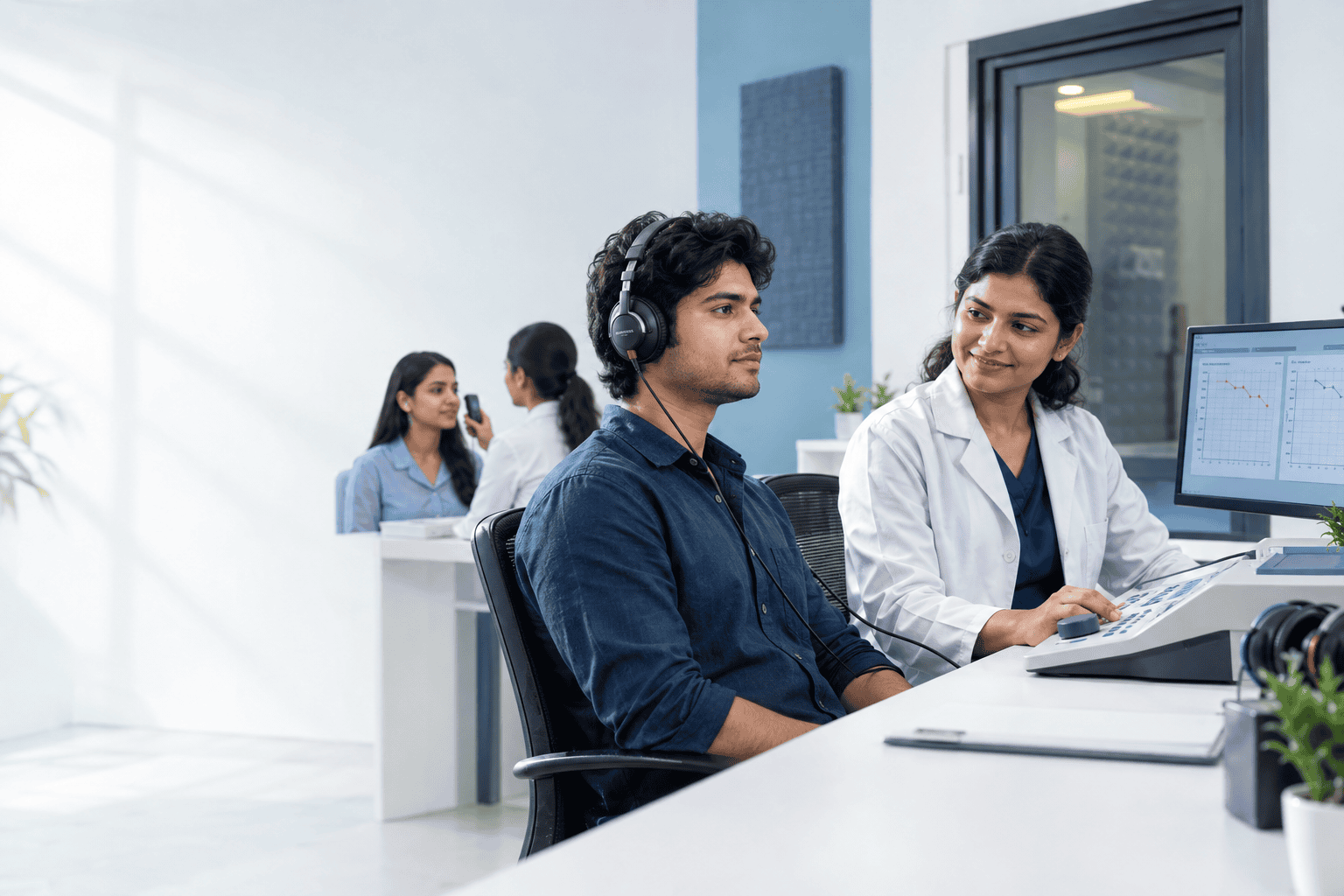
Step 3: Hearing Assessment
Depending on the available equipment and the purpose of the visit, appropriate hearing screening or assessment procedures may be performed.
It is important to understand that not every “home hearing test” is the same.
A smartphone application or online hearing screener can provide a basic indication that someone may have a hearing problem, but such tools are not necessarily equivalent to a professional diagnostic hearing assessment. WHO also states that screening tools such as hearWHO do not replace assessment by a qualified hearing-care professional.
For this reason, families should ask what type of test is being provided and who will perform it.
Step 4: Explanation of the Results
After the assessment, the hearing professional can explain the findings in understandable language.
The purpose should not simply be to provide a technical report. The senior and family should understand what the results mean for everyday communication and what the appropriate next step may be.
Benefits of Hearing Assessment at Home
A home hearing test for senior citizens can offer several practical benefits when home assessment is suitable.
Less Travel for the Senior
For an older adult who finds travelling difficult, a home visit can remove one of the practical barriers to getting hearing care.
Family Can Be Present
Family members can listen to the explanation, ask questions and help the senior remember the recommendations.
Convenient for Caregivers
Adult children often manage appointments for elderly parents. A hearing assessment at home may make scheduling easier when travelling to a centre is difficult.
Personalised Discussion
A hearing professional can discuss the person’s everyday listening situations and concerns rather than focusing only on a test result.
Easier Follow-Up
Depending on the provider and location, home-based hearing care may also make certain follow-up services more convenient.
Is a Home Hearing Test the Same as an Online Hearing Test?
No.
This is an important distinction.
An online hearing test or smartphone screening tool generally uses headphones or device speakers and provides an indication based on the user’s responses. Results can be affected by the device, headphones, environment and background noise.
A professional home hearing test for senior citizens, when conducted with appropriate equipment by a qualified professional, is a different type of service.
WHO describes hearing screening as a process that can take place in clinical, community or home settings, depending on the local context and available resources.
If a screening result suggests a hearing concern, further professional assessment may be recommended.
When Should Senior Citizens Get Their Hearing Checked?
There is no need to wait until hearing difficulty becomes severe before asking about hearing care.
WHO recommends regular hearing screening for adults beginning at age 50, with screening frequency increasing from age 65, depending on the circumstances.
A hearing check can also be considered when there are noticeable changes in everyday communication.
For example, if a senior frequently asks people to repeat themselves, struggles with conversations, regularly increases the television volume or experiences ringing in the ears, a hearing evaluation may be appropriate.
The important point is not to assume that every hearing difficulty is simply “because of age.” Different ear and hearing conditions can have different causes, and an appropriate professional assessment can help determine what needs to be considered.
Home Hearing Test for Senior Citizens in Sirsa
For families in Sirsa, arranging hearing care at home can be a practical option when an older family member finds travelling inconvenient.
If your parent or grandparent is frequently asking for repetition, increasing television volume or struggling with family conversations, consider discussing a home hearing test for senior citizens with a qualified hearing-care professional.
Local families can also search for terms such as hearing test in Sirsa, home hearing test in Sirsa and audiologist home visit in Sirsa when looking for suitable hearing services.
Home Hearing Test for Senior Citizens in Hisar
Families in Hisar may also look for convenient hearing assessment options for elderly parents.
A home hearing test for senior citizens can be particularly useful when mobility, transportation or repeated clinic visits are a concern.
A professional can discuss the senior’s hearing difficulties, perform the appropriate assessment available through the home service and explain whether further evaluation is required.
For local searches, relevant terms include hearing test in Hisar, hearing assessment at home in Hisar and senior hearing test in Hisar.
Home Hearing Test for Senior Citizens in Rohtak
In Rohtak, families looking for hearing care for elderly parents may consider a home-based assessment where the service is available and clinically appropriate.
A home hearing test for senior citizens can allow the senior to remain in a familiar environment while discussing hearing concerns with a hearing professional.
Searching for hearing test in Rohtak, home hearing test in Rohtak or audiologist home visit in Rohtak can help families explore available services.
Home Hearing Test for Senior Citizens in Hanumangarh
For families in Hanumangarh, hearing difficulties in an older family member should not be ignored simply because the changes have developed slowly.
A home hearing test for senior citizens may be a convenient option for families who prefer assessment at home, subject to service availability and the type of testing required.
Local searches such as hearing test in Hanumangarh and hearing assessment at home in Hanumangarh can help families find appropriate hearing-care options.
Home Hearing Test for Senior Citizens in Bathinda
Families in Bathinda can also consider home-based hearing care when an elderly family member has difficulty travelling to a hearing centre.
A home hearing test for senior citizens can be useful for understanding whether further hearing evaluation may be needed.
People searching locally may use terms such as hearing test in Bathinda, home hearing test in Bathinda and hearing test for elderly in Bathinda.
What Should You Do Before the Appointment?
A little preparation can make the appointment more useful.
Before a home hearing test for senior citizens, family members can make a short list of situations where the senior has difficulty hearing.
For example:
- Difficulty hearing family conversations
- Difficulty hearing on the telephone
- Television volume becoming higher
- Difficulty understanding speech in noisy places
- Frequently asking people to repeat themselves
- Difficulty hearing alarms or doorbells
- Any history of previous hearing tests or hearing devices
It can also be helpful for the senior to bring or keep nearby any previous hearing reports or hearing aids, if applicable.
What If the Hearing Test Shows a Hearing Problem?
A hearing test is an important step, but it is not necessarily the end of the process.
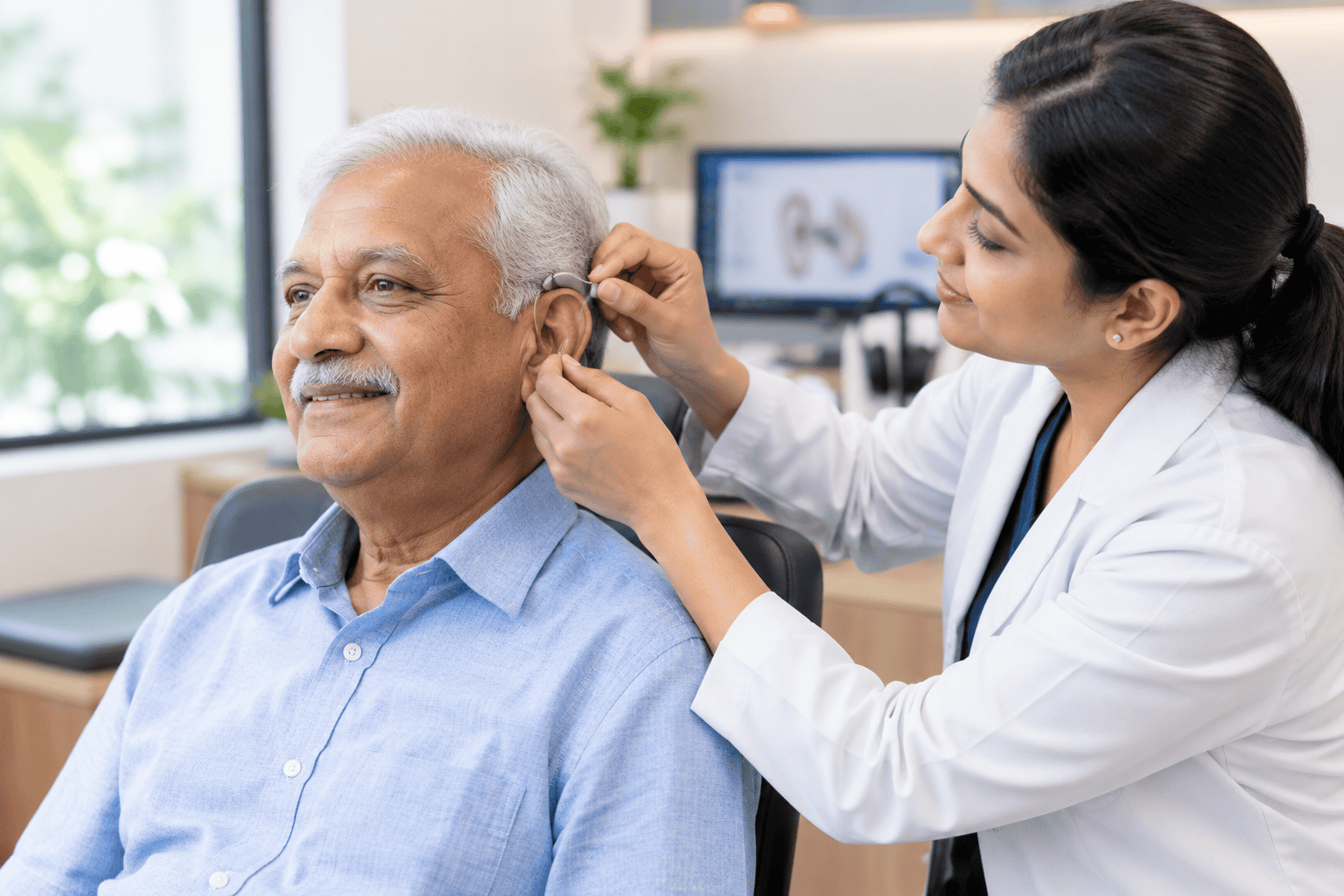
Depending on the findings, the hearing professional may recommend further assessment, monitoring, communication strategies, hearing technology or referral to another healthcare professional.
Not everyone with a hearing difficulty will have the same needs.
The right next step depends on the individual’s hearing results, ear health, communication requirements, lifestyle and other relevant factors.
This is why a professional assessment is more useful than choosing a hearing device based only on an online test or another person’s experience.
Why Early Attention to Hearing Matters
Hearing difficulties can affect everyday communication. WHO notes that unaddressed hearing loss can affect communication and may contribute to social isolation and loneliness, particularly among older adults.
Getting a hearing concern checked does not mean that a senior must immediately use a hearing aid.
It simply means understanding the situation and discussing suitable options with a hearing-care professional.
For families, taking the first step can be as simple as arranging a home hearing test for senior citizens and asking the right questions.
Choose Convenient Hearing Care with Hear At Home
For elderly parents and grandparents, hearing care should be convenient, understandable and focused on their individual needs.
Hear At Home is focused on making hearing-care services more accessible for families who prefer support at home.
If you are looking for a home hearing test for senior citizens in Sirsa, Hisar, Rohtak, Hanumangarh or Bathinda, you can contact Hear At Home to understand the availability of home-based hearing services and the type of assessment suitable for the senior.
A hearing concern does not need to be ignored simply because it developed gradually. A professional hearing assessment can help you understand the situation and decide what to do next.
Conclusion
Hearing is an important part of staying connected with family, friends and everyday surroundings. When an older adult begins struggling with conversations, television, phone calls or sounds around the home, it may be time to consider a hearing assessment.
A home hearing test for senior citizens can provide a convenient way to begin addressing these concerns, particularly when travelling to a clinic is difficult.
The most important step is to avoid guessing. Online screening tools, family observations and everyday symptoms can raise awareness, but a suitable professional hearing assessment can provide a clearer understanding of the person’s hearing needs.
If you are looking for hearing care for an elderly family member in Sirsa, Hisar, Rohtak, Hanumangarh or Bathinda, consider contacting Hear At Home to discuss a suitable hearing assessment.
Hear Better. Connect Better. Live Better.